
The successful launch of the maiden solar mission of the Indian Space Research Organisation came on the heels of the historic lunar landing mission - Chandrayaan-3.

'What we have done is a symbol of new India; that is what a small start-up can do, a few hundreds of people coming together, developing a rocket and launching to space and succeeding at the very first attempt.'

The new year will witness two unmanned missions under the "Gaganyaan" project, deep ocean exploration project, "Samudrayaan" and many more.

Indian Space Research Organisation will announce a revised launch date later.

On Thursday, the four-stage, 44.4 metre tall PSLV-C53 that blasted off from the second launch pad of Satish Dhawan Space Centre and placed the three Singapore satellites--DS-EO, NeuSAR and SCOOB-1 in intended orbit.

ISRO's first mission in 2023 and SSLV's sequel saw a strange coincidence--it was launched at 9.18 am, the same time its predecessor lifted off from the Satish Dhawan Space Centre here on August 7, 2022 but could not deliver due to orbit anomaly and flight path deviation.

In the first dedicated mission of its commercial arm New Space India Limited (NSIL), the Indian Space Research Organisation on Sunday successfully launched Brazil's earth observation satellite Amazonia-1 and 18 other co-passengers, including five built by students, onboard a Polar rocket from the spaceport in Sriharikota.

On Sunday morning, in its mission to place an earth observation satellite and students satellite into the low earth orbit, the SSLV-D1/EOS-02 blasted off precisely at 9.18 am amid cloudy skies from the first launch pad at Satish Dhawan Space Centre in this spaceport.

Aditya-L1 will be launched by PSLV-C57 rocket on September 2 at 11:50 am. It carries seven payloads to study the Sun, four of which will observe the light from the Sun and the remaining three will measure insitu parameters of the plasma and magnetic fields.
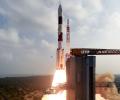
The 2,268-kg GISAT-1 was originally slated to be launched from Sriharikota in Andhra Pradesh's Nellore district, about 100 kms north of Chennai, on March 5 last year but was postponed a day before the blast-off due to technical reasons.

The 51-hour countdown for India's landmark 100th space mission began on Friday with Indian Space Research Organisation's old warhorse Polar Satellite Launch Vehicle rocket all set to soar into space on September 9 with two foreign satellites from the spaceport of Sriharikota in Andhra Pradesh.

India scripted history by successfully launching EMISAT, a military satellite, and 28 foreign nano satellites on-board its polar rocket from Sriharikota on Monday, in a complex mission which marked many a first for Indian Space Research Organisation.

In his latest monthly radio address, Mann Ki Baat, Modi said that India is capable of providing solutions to the varied challenges being faced globally.
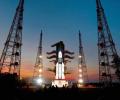
Despite the odd time, hordes of enthusiasts had reached the island, some of them travelling long distances on two wheelers, to witness the historic moment.
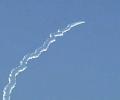
India on Monday successfully launched the first technology demonstrator of indigenously made Reusable Launch Vehicle, capable of launching satellites into orbit around earth and then re-enter the atmosphere, from Sriharikota in Andhra Pradesh.

The 3,423 kg GSAT-29 carries Ka and Ku band high throughput transponders intended to meet the communication requirements of users, including in the North East and in Jammu and Kashmir.

ISRO has released the footage of the injection of PSLV-37 which launched a record 104 nano-satellites overseas customers into the orbit in blocks in a series of separations.

India is the fourth country to demonstrate the flight testing of Scramjet Engine after the United States, Russia and European Space Agency.
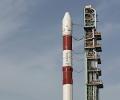
ISRO said, initially the launch was slated for 9.49 am, but now there is a 3-minute delay owing to the probability of space debris in the path of rocket.
India's top space scientists will be meeting in Thiruvananthapuram on Saturday to analyse the data and find the cause for failure of GSLV-D3 rocket, which was launched for the first time on Thursday using an indigenously made cryogenic engine.
Launch of India's latest communication satellite GSAT-5P onboard homegrown GSLV-F06, powered by Russian cryogenic engine, failed on Saturday when the rocket developed a snag soon after lift-off from the spaceport in Sriharikota.

ISRO Chairman K Sivan said there might by a postponement if the weather was not conducive.

India on Monday successfully launched its second lunar mission Chandrayaan-2 onboard its powerful rocket GSLV-MkIII-M1 from the spaceport in Sriharikota to explore the unchartered south pole of the celestial body by landing a rover. Following the successful launch, leaders across the political spectrum congratulated the Indian Space Research Organisation for its hard work.
The PSLV-C8 rocket will make its first commercial launch with an Italian astronomical satellite on board.
India on Monday successfully launched five foreign satellites from four countries on board PSLV-C23 rocket which placed them in orbit, an achievement described by Prime Minister Narendra Modi as an 'endorsement' of the country's space capabilities.
The GSLV will put into orbit the INSAT-4CR, which carries 12 high-power Ku-band transponders for direct-to-home television services, video picture transmission and digital satellite news gathering.

The image shows a part of Indore with the Holkar Cricket Stadium in the centre.
Indian Space agency Indian Space Research Organisation would launch the Geo-synchronous Satellite Launch Vehicle-Mark III (LVM3 X mission) on December 18 which would carry active solid boosters, liquid core stage and a passive cryo-stage.

Andhra Pradesh Chief Minister N Chandrababu Naidu on Monday met the victims of the building collapse incident in Chennai and promised to provide necessary medical care and relief on a "war-footing" for them.

The Mars Colour Camera onboard Indian Space Research Organisation's Mars Orbiter Mission has captured the image of Phobos, the closest and biggest moon of Mars.

'You declare a date, time and place for the landing two months in advance and exactly at that moment, it touched on the moon.'
A symbol of self-reliance, India's space endeavours are a model for public-private partnership.

The successful orbiting of the satellites by the Polar Satellite Launch Vehicle PSLV C-40 comes four months after the Indian space Research Organisation's mission to launch backup navigation spacecraft IRNSS-1H onboard PSLV-39 ended in a rare failure.
India's Polar Satellite Launch vehicle-C16 rocket on Wednesday successfully launched into orbit the latest remote sensing satellite Resourcesat-2 that would study and help manage natural resources along with two nano satellites.
ISRO sources said that with Sunday's mission, the agency has launched 62 satellites, one space recovery module and 37 rockets, making it a grand 100

The countdown began at 6.27 am for the launch on board ISRO's third generation workhorse Polar Satellite Launch Vehicle, in its 47th flight, ISRO said.

Swapnila said they saw the GSLV Mk-III rocket that will launch the mission into space. "It was so huge," she added.
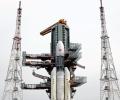
The Indian Space Research Organisation said that the countdown started at 6.51 am on Sunday.

India on Wednesday successfully launched a record 104 satellites -- all but three of them foreign--from Sriharikota and put them into orbit in a single mission onboard its most dependable Polar rocket.
